
Find the Type of Glass Product Right for You
Fire-Rated Glass
Glass Fabricators carries Schott’s Pyran Platinum line of fire-rated products. This is a specialized ceramic product, either backed or laminated with a plastic layer that delays heat transmission through the product. This requires specialty sizing and marking requirements. More information is available upon request.
Tempered Glass
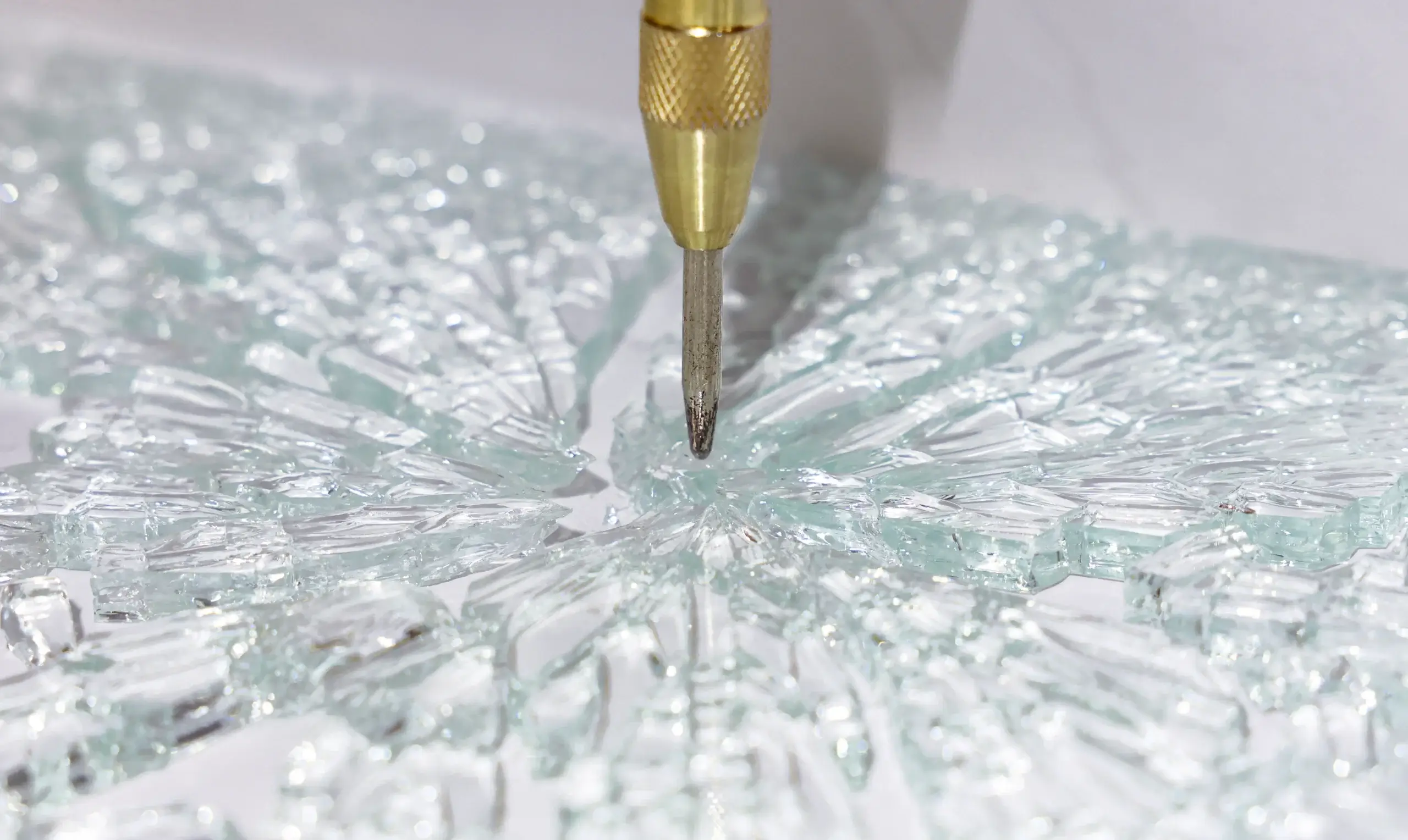
When broken, tempered glass breaks into a multitude of small fragments of a somewhat cubical shape. Tempered glass meeting ANSI Z97.1 requirements is qualified as a safety glazing material.
Tempered glass is fabricated by subjecting annealed glass to a special heat-treating process. Most processes heat the glass to 1150 degrees F, then rapidly cool it by blowing air uniformly onto both surfaces simultaneously. The cooling process locks the surfaces of the glass in a state of high compression and the central core in compensating tension, so any fracture that crosses the tension/compression boundary will cause the entire lite of tempered glass to relieve. The color, clarity, chemical composition, and light transmission characteristics remain unchanged.
Tempered glass is approximately four times stronger than annealed glass. Heat-strengthened glass is approximately twice as strong as annealed glass.
Fabrication, such as cutting, drilling, or edging is done before the tempering process.
Laminated Glass
Laminated glass can be made in many combinations of clear, tinted, low-E, or solar-reflective glasses. Polyvinyl butyral (PVB), the most commonly used sheet interlayer material, is available in thicknesses from .15” to .90”, with .30” as the most common.
When laminated glass is fractured, the particles of glass tend to adhere to the plastic, affording protection against flying or falling particles. Architectural-laminated glass, which satisfies the safety requirements for Category II materials, is generally two lites of annealed glass with a .30” interlayer.
Burglar-resisting glass covers standards for “smash and grab” type burglaries and tests only for minimal commercial security. It generally uses a special plastic interlayer resistant to penetration.
Bullet-resistant glass usually consists of multiple lites of glass, plastic interlayers, and can include layers of polycarbonate.
Glass Fabricators currently offers ¼” – 9/16” lami with a wide array of fabrication and edge polish options. Contact us to see what application will work best for your product.